 99268 21000
 99268 21000
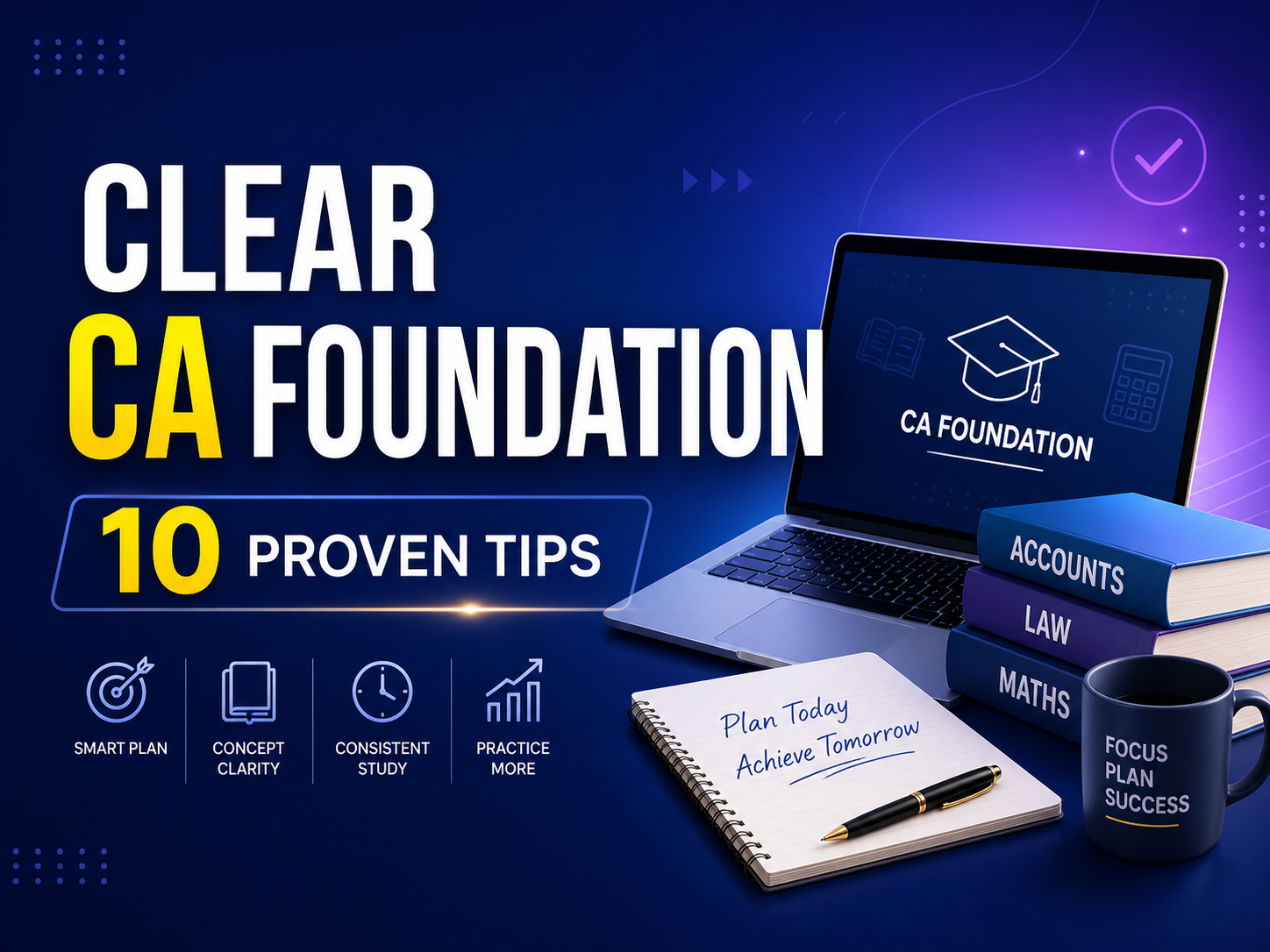
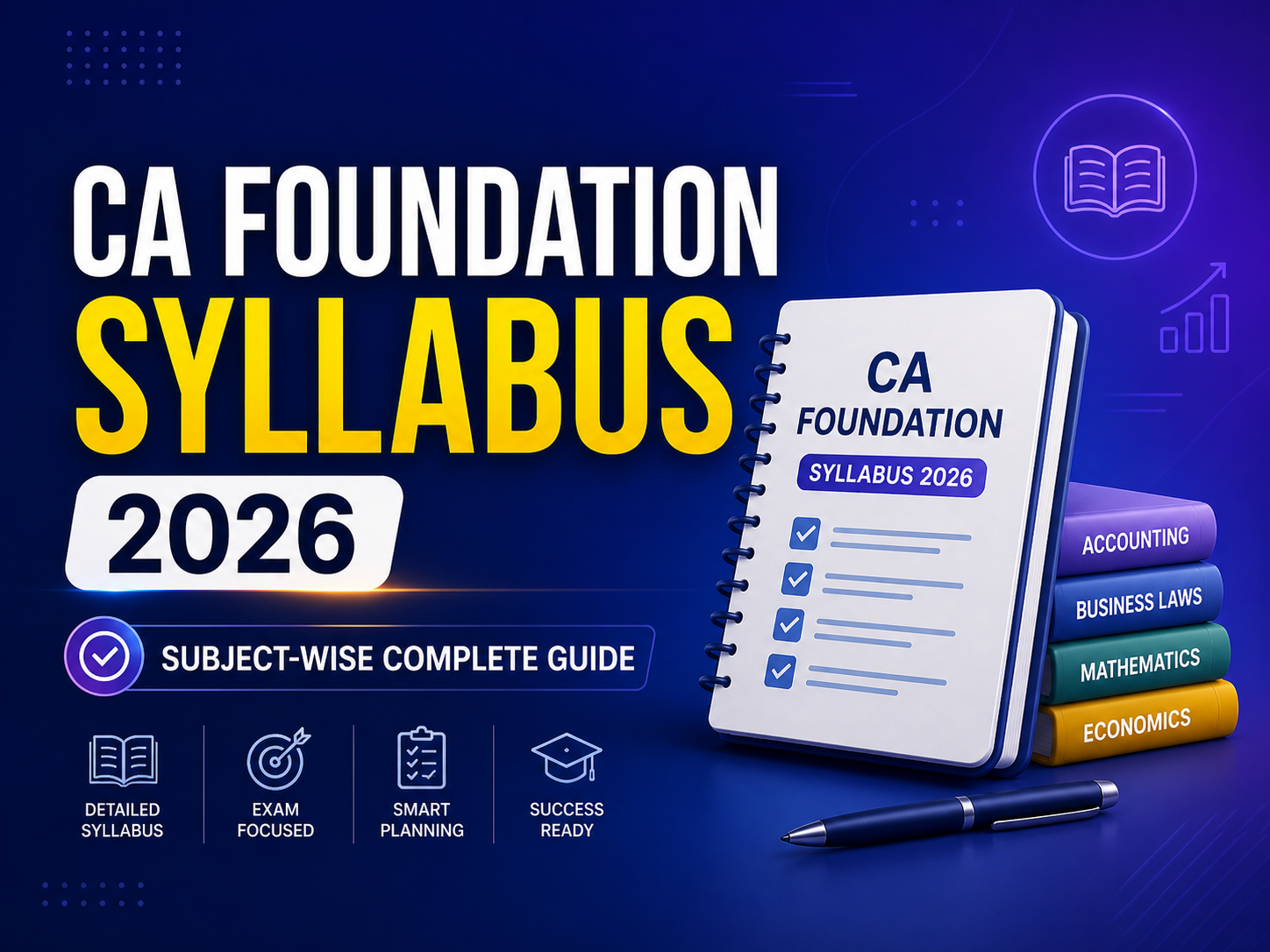
CA Foundation Syllabus 2026: Subject-Wise Complete Guide
CA Foundation Syllabus 2026: Subject-Wise Complete Guide
Every chapter, topic, and weightage you need — in both Hindi and English medium
The CA Foundation exam is your entry point to the prestigious Chartered Accountancy profession. This guide covers the complete 2026 syllabus as prescribed by ICAI, with chapter-wise topics, difficulty levels, study tips, and medium-specific guidance — everything a student needs to plan their preparation from Day 1.
Quick Facts
CA Foundation has 4 papers, 400 total marks. You need 50% aggregate and minimum 40% per paper to pass. Papers 1 & 2 are descriptive; Papers 3 & 4 are objective MCQ with negative marking of 0.25 marks per wrong answer. Note: Section B of Paper 2 must be answered in English only. Both Hindi and English medium are available for the rest.
📋 Table of Contents
Exam Overview & Key Stats
Before diving into each subject, here are the four essential numbers every CA Foundation aspirant must know.
| Paper | Paper 1 | Paper 2 | Paper 3 | Paper 4 |
|---|---|---|---|---|
| Subject | Accounts | Business Laws | Quant Aptitude | Business Economics |
| Marks | 100 | 100 | 100 | 100 |
| Format | Descriptive | Descriptive | Objective MCQ | Objective MCQ |
| Duration | 3 Hours | 3 Hours | 2 Hours | 2 Hours |
| Negative Marking | No | No | ⚠️ Yes — 0.25 per wrong MCQ | ⚠️ Yes — 0.25 per wrong MCQ |
| Difficulty | ⭐⭐⭐⭐⭐ | ⭐⭐⭐ | ⭐⭐⭐⭐ | ⭐⭐⭐ |
Paper-wise Syllabus Breakdown
Here is the complete chapter-by-chapter syllabus for all four papers, with study tips and key topics for each.
Principles & Practice of Accounting
The most important and scoring paper of CA Foundation. It tests your understanding of basic accounting principles, journal entries, ledgers, and financial statements. Daily practice is absolutely essential for this paper.
- 1Theoretical FrameworkAccounting principles, concepts, conventions, GAAP basics
- 2Accounting ProcessJournal, Ledger, Trial Balance, Cash Book, Subsidiary Books
- 3Bank Reconciliation StatementDifferences, BRS preparation, causes of difference
- 4InventoriesFIFO, LIFO, Weighted Average, valuation methods
- 5Depreciation, Provisions & ReservesSLM, WDV methods, change in method
- 6Bills of Exchange & Promissory NotesBill transactions, accommodation bills, dishonour
- 7Rectification of ErrorsTypes of errors, suspense account, trial balance adjustment
- 8Partnership AccountsAdmission, retirement, death, dissolution, reconstitution
- 9Financial Statements of CompaniesBalance Sheet, P&L format as per Companies Act
- 10Single Entry SystemStatement of Affairs, ascertainment of profit
Study Tip: Partnership Accounts and Financial Statements carry the highest weightage. Practice at least 3 problems from these chapters every day. Use ICAI RTPs (Revision Test Papers) from the last 4 exams.
Business Laws
Business Laws requires reading and understanding key Indian laws governing commerce and business. Unlike accounts, this is conceptual — you need to understand the spirit of each law, not memorize sections blindly.
- 1The Indian Contract Act, 1872Offer, acceptance, consideration, types of contracts, void agreements, discharge
- 2The Sale of Goods Act, 1930Sale vs. agreement to sell, conditions, warranties, rights of unpaid seller
- 3The Indian Partnership Act, 1932Types of partners, rights/duties, dissolution, limited liability partnership
- 4The Limited Liability Partnership Act, 2008LLP formation, incorporation, contributions, obligations
- 5The Companies Act, 2013 (Basics)Types of companies, incorporation, MOA, AOA, prospectus
Study Tip: Indian Contract Act is the most asked chapter. Learn the definitions, exceptions, and case-law examples. For Laws, create short "chapter summaries" of 1 page each and revise those in the last 2 weeks.
Quantitative Aptitude
This paper has two parts — Business Mathematics and Business Statistics. It's fully MCQ-based. Important: there is negative marking of 0.25 marks per wrong answer under the new scheme. Speed, accuracy, and formula mastery are critical — don't attempt questions you're unsure about.
Part A: Business Mathematics
- 1Ratio & Proportion, Indices, LogarithmsFundamental concepts, compound interest applications
- 2EquationsLinear, simultaneous, quadratic equations and their applications
- 3Linear InequalitiesSolving and graphical representation
- 4Time Value of MoneySimple interest, compound interest, present value, future value, annuity
- 5Permutations & CombinationsFactorial notation, nPr, nCr, applications
- 6Sequence & SeriesAP, GP — sum, nth term, applications
- 7Sets, Relations & FunctionsTypes, operations, Venn diagrams
Part B: Business Statistics
- 8Statistical Description of DataClassification, tabulation, frequency distribution, graphs
- 9Measures of Central Tendency & DispersionMean, Median, Mode, SD, Variance, Quartile Deviation
- 10ProbabilityClassical, relative frequency, Bayes theorem, conditional probability
- 11Theoretical DistributionsBinomial, Poisson, Normal distribution basics
- 12Correlation & RegressionKarl Pearson's coefficient, Spearman rank, regression lines
- 13Index Numbers & Time SeriesLaspeyre's, Paasche's, Fisher's index; trend analysis
Study Tip: Time Value of Money and Measures of Central Tendency are the highest-scoring topics. Memorize formulas on a cheat sheet and revise daily. Because of the 0.25 negative marking, attempt MCQs only when you have a clear idea — eliminate wrong options rather than guessing randomly.
Business Economics
Business Economics covers micro and macro economic concepts and their business applications. It's conceptual and MCQ-based, making it very scoring once the concepts are clear. Many students score 70–80% in this paper.
- 1Introduction to Business EconomicsNature, scope, micro vs. macro economics, economic systems
- 2Theory of Demand & SupplyDemand law, elasticity, supply law, equilibrium, shifts
- 3Theory of Production & CostLaw of variable proportions, returns to scale, cost curves
- 4Price Determination in Different MarketsPerfect competition, monopoly, monopolistic competition, oligopoly
- 5Business CyclesPhases of business cycles, causes, effects, policies
- 6Determination of National IncomeGDP, GNP, NNP, national income concepts, multiplier
- 7Public FinanceGovernment budget, fiscal policy, taxation, public expenditure
- 8Money MarketMoney supply, RBI functions, monetary policy, credit control
- 9Indian Economy (Current Topics)GDP growth, inflation, Balance of Payments, economic reforms
Study Tip: Chapter 2 (Demand & Supply) and Chapter 4 (Market Structures) are the most asked. Read current RBI & budget news 2 months before the exam for Chapters 8 & 9 questions that appear every session.
📚 Hindi Medium vs English Medium
ICAI allows you to attempt CA Foundation in either Hindi or English. Here's what you need to know before choosing your medium.
🇮🇳 Hindi Medium
- Papers 1, 3 & 4 fully available in Hindi
- Paper 2 (Business Laws): Section A in Hindi allowed; Section B compulsory in English
- ICAI official Hindi study material provided
- Best for students from Hindi-speaking regions
- EEI offers dedicated Hindi medium coaching batches
- No marks penalty for Hindi medium students
🏴 English Medium
- All 4 papers available in English
- ICAI study material in English is more detailed
- Preferred for students planning Big 4 careers
- More reference books and resources available
- Higher competition but broader resource pool
- Recommended if comfortable with English terminology
Paper Weightage & Passing Strategy
All four papers carry equal marks (100 each), but they differ significantly in difficulty and scoring potential. Here's how to allocate your preparation time.
| Paper | Scoring Potential | Effort Level | Recommended Time |
|---|---|---|---|
| P1 — Accounts | High (with practice) | Very High | 35–40% of study time |
| P2 — Business Laws | Moderate | Moderate | 20–25% of study time |
| P3 — Quant Aptitude | High (formula-based) | High | 25–30% of study time |
| P4 — Business Economics | Very High | Low–Moderate | 15–20% of study time |
Start Your CA Foundation Journey
Excel Educational Institute in Raipur offers dedicated CA Foundation batches in both Hindi & English medium — with complete ICAI syllabus coverage, mock tests, and mentorship.
Download Free Syllabus PDF →
.jpeg)