 99268 21000
 99268 21000
What is CMA (Cost Accountant) Course? Salary, Scope & Career in India
Everything a student needs to know about the CMA course — full form, levels, syllabus, fees, salary data, career scope, and job roles in India
The CMA (Cost and Management Accountant) course — conducted by the Institute of Cost Accountants of India (ICMAI) — is one of India's three premier professional accounting qualifications alongside CA and CS. A CMA is a specialist in cost management, budgeting, financial planning, performance analysis, and strategic decision-making. With rising demand across manufacturing, PSUs, banking, pharma, and consulting, the CMA qualification opens doors to highly rewarding careers in India and abroad. This guide covers everything — from course structure and syllabus to salary data, career scope, and job roles.
Quick Answer — What is CMA?
CMA stands for Cost and Management Accountant. It is a professional qualification awarded by ICMAI (formerly ICWAI) — a statutory body under an Act of Parliament. The course has 3 levels (Foundation → Intermediate → Final), takes 3–4 years to complete, and can be started after Class 10th or 12th. Freshers earn ₹4–8 LPA; senior CMAs can earn ₹50 LPA or more.
📋 Table of Contents
What is CMA? Full Form, Meaning & Governing Body
The full form of CMA in India is Cost and Management Accountant. The designation is awarded by the Institute of Cost Accountants of India (ICMAI), formerly known as ICWAI (Institute of Cost and Works Accountants of India). ICMAI is a statutory body established under an Act of Parliament, making its qualification legally recognized across India.
CMAs are financial professionals trained in:
Cost Accounting
Analysing, tracking, and controlling production and operational costs in manufacturing and services.
Budgeting & Planning
Building company-wide financial plans, budgets, forecasts, and performance benchmarks.
Financial Management
Capital allocation, working capital management, and investment decision support.
Internal Audit & Control
Ensuring internal controls, risk management systems, and regulatory compliance are in place.
Strategic Decision Support
Providing management with data-driven insights for pricing, outsourcing, and expansion decisions.
📌 Key Fact: ICMAI is a statutory body recognized by the Government of India under the Cost and Works Accountants Act, 1959. The CMA designation in India is legally distinct from the US CMA (awarded by IMA, USA). This blog covers the Indian CMA (ICMAI) qualification.
CMA Course Structure: 3 Levels Explained
The CMA course is structured into three progressive levels. Students can enter at different stages depending on their existing qualification. Each level must be cleared before progressing to the next.
Level 1 — CMA Foundation
- Fundamentals of Economics & Management
- Fundamentals of Accounting
- Fundamentals of Laws & Ethics
- Fundamentals of Business Mathematics & Statistics
- Entry point after Class 10th or 12th
- Exams: June & December each year
Level 2 — CMA Intermediate
- After Foundation or direct entry (graduates)
- Group I and Group II — 4 papers each
- 100 marks per paper · No negative marking
- Exam mode: Offline, centre-based
- 30% MCQ 70% Descriptive format
- Practical training: 15 months (post-Inter)
Level 3 — CMA Final
- After clearing CMA Intermediate
- Group III and Group IV — 4 papers each
- Elective paper in Final — choose your specialisation
- Advanced topics: strategy, valuation, global finance
- Pass rate: ~25% (highly competitive)
- On clearing: awarded CMA designation by ICMAI
| Parameter | CMA Foundation | CMA Intermediate | CMA Final |
|---|---|---|---|
| Eligibility | After Class 10th / 12th | After Foundation or Graduation (direct entry) | After Intermediate clearance |
| Total Papers | 4 Papers | 8 Papers (Group I & II) | 8 Papers (Group III & IV) |
| Total Marks | 400 Marks | 800 Marks | 800 Marks |
| Passing Criteria | 40% per paper 50% aggregate | 40% per paper 50% per group | 40% per paper 50% per group |
| Exam Frequency | June & December | June & December | June & December |
| Duration to Clear | 6–8 months | 1–2 years | 1–2 years |
| Practical Training | Not required | Not required | 15 months (before/during Final) |
| Exam Fee (approx.) | ₹1,200 per group | ₹1,800 per group | ₹2,000 per group |
CMA Syllabus 2026 — Inter & Final Papers
The current CMA syllabus (CMA Syllabus 2022, applicable for 2026 exams) covers 8 papers at both Intermediate and Final levels. ICMAI is developing a new 2026 syllabus — expected to be implemented from 2027 — with updated focus on data analytics, ESG, and AI in finance.
CMA Intermediate Syllabus — Group I & Group II
Group I — Papers 1 to 4
Statutory compliance, cost, and tax fundamentals
- Financial Accounting
- Corporate Laws & Compliance
- Direct & Indirect Taxation
- Cost Accounting
Group II — Papers 5 to 8
Management, operations, audit & analytics
- Operations Management & Strategic Management
- Financial Management & Business Data Analytics
- Corporate Financial Reporting
- Indirect Tax Laws & Practice
CMA Final Syllabus — Group III & Group IV
Group III — Papers 13 to 16
Corporate strategy, cost leadership, and valuation
- Corporate and Economic Laws
- Strategic Financial Management
- Strategic Cost Management — Decision Making
- Direct Tax Laws & International Taxation
Group IV — Papers 17 to 20
Audit, indirect tax, and one elective paper
- Corporate Financial Reporting
- Indirect Tax Laws & Practice
- Cost & Management Audit
- Paper 20 — Elective (choose 1): Strategic Performance Management / Risk Management / Entrepreneurship & Startups
💡 New in 2026 Syllabus: ICMAI has introduced Business Data Analytics as a mandatory component in Intermediate (Paper 6) and is integrating ESG reporting, AI in auditing, and SAP ERP training into the curriculum. SAP Finance Power User Training is compulsory before appearing for both Inter groups under the latest scheme.
CMA Salary in India (2026) — Fresher to CFO Level
CMA salaries in India have grown significantly in recent years. The average ICMAI campus placement package in 2025 reached ₹10–13 LPA, with top offers reaching ₹26–27 LPA for freshers. Here is a realistic, data-backed breakdown across experience levels.
Salary by Industry / Employer Type
| City / Location | Fresher CMA Salary | Mid-Level Salary |
|---|---|---|
| Mumbai | ₹5–12 LPA | ₹15–30 LPA |
| Delhi / NCR | ₹4.5–10 LPA | ₹14–28 LPA |
| Bengaluru | ₹4–9 LPA | ₹12–25 LPA |
| Chennai | ₹3.5–8 LPA | ₹10–22 LPA |
| Hyderabad | ₹3.5–8 LPA | ₹10–20 LPA |
| Kolkata | ₹3–7 LPA | ₹8–18 LPA |
| Raipur / Chhattisgarh | ₹3.5–6 LPA | ₹8–15 LPA |
| Bhopal / Indore (MP) | ₹3.5–7 LPA | ₹8–16 LPA |
Job Roles & Career Opportunities for CMA
A CMA can work in a wide range of finance and management roles. Here are the most common career paths and their salary ranges:
-
Cost Accountant / Cost Manager Core CMA role — manufacturing, PSUs, pharma · 0–5 years₹4–12 LPA
-
Financial Controller Oversees financial reporting, budgets, and compliance · 5–10 years₹15–35 LPA
-
Finance Manager / CFO Strategic financial leadership in corporates · 10 years₹25–1 Cr
-
Management Accountant Decision support, KPI tracking, variance analysis · 2–6 years₹6–18 LPA
-
Internal Auditor Risk, controls, and compliance auditing · 2–7 years₹6–16 LPA
-
Cost Audit Professional (Statutory) Mandatory cost audit of manufacturing companies under Companies Act₹8–20 LPA
-
FP&A Analyst / Business Analyst Financial planning & analysis, forecasting · MNCs, startups · 2–6 years₹7–20 LPA
-
CMA in Own Practice (Consulting) Cost audit, management consulting, advisory · 5 yearsUnlimited
✅ Exclusive Right of CMAs: Under the Companies Act 2013, companies above a certain turnover threshold are required to get their cost records audited by a Cost Auditor — who must be a qualified ICMAI CMA in practice. This statutory mandate creates exclusive employment opportunities for CMAs that no other professional can perform.
Career Scope & Industry Demand for CMA in India (2026)
The demand for CMAs is growing steadily driven by India's industrial expansion, GST compliance requirements, increasing PSU hiring, and the push for cost efficiency across sectors. Here are the sectors with the highest CMA demand:
Manufacturing & Steel
₹5–18 LPASAIL, Tata Steel, JSW, NMDC — India's largest employers of CMAs
Power & Energy (PSUs)
₹6–15 LPANTPC, BHEL, SECL, ONGC — consistent PSU hiring with job security
Banking & NBFC
₹6–20 LPASBI, ICICI, Axis, HDFC Bank — internal audit, compliance, FP&A roles
Pharma & Healthcare
₹5–15 LPASun Pharma, Cipla, Dr Reddy's — cost management critical in regulated pharma
Infrastructure & Mining
₹5–14 LPACoal India, L&T, RITES — cost control in large-scale capital projects
Big 4 Consulting Firms
₹10–25 LPADeloitte, EY, KPMG, PwC — top packages in management accounting advisory
Global Recognition
ICMAI has MoUs with accounting bodies in 100 countries. CMAs are recognized globally, especially in the Middle East, UK, and Southeast Asia.
Statutory Mandate
Companies Act 2013 mandates cost audit by a CMA for specific industries. This creates guaranteed, exclusive employment that cannot be filled by any other qualification.
Future-Proof Skills
New ICMAI syllabus integrates data analytics, ESG, AI in finance, and SAP ERP — making CMAs prepared for digital finance roles of 2026 and beyond.
Salary Growth Trajectory
CMAs in India earn 25–35% more than non-certified finance professionals. Campus placement packages grew 30% in 2025, with top offers hitting ₹26 LPA for freshers.
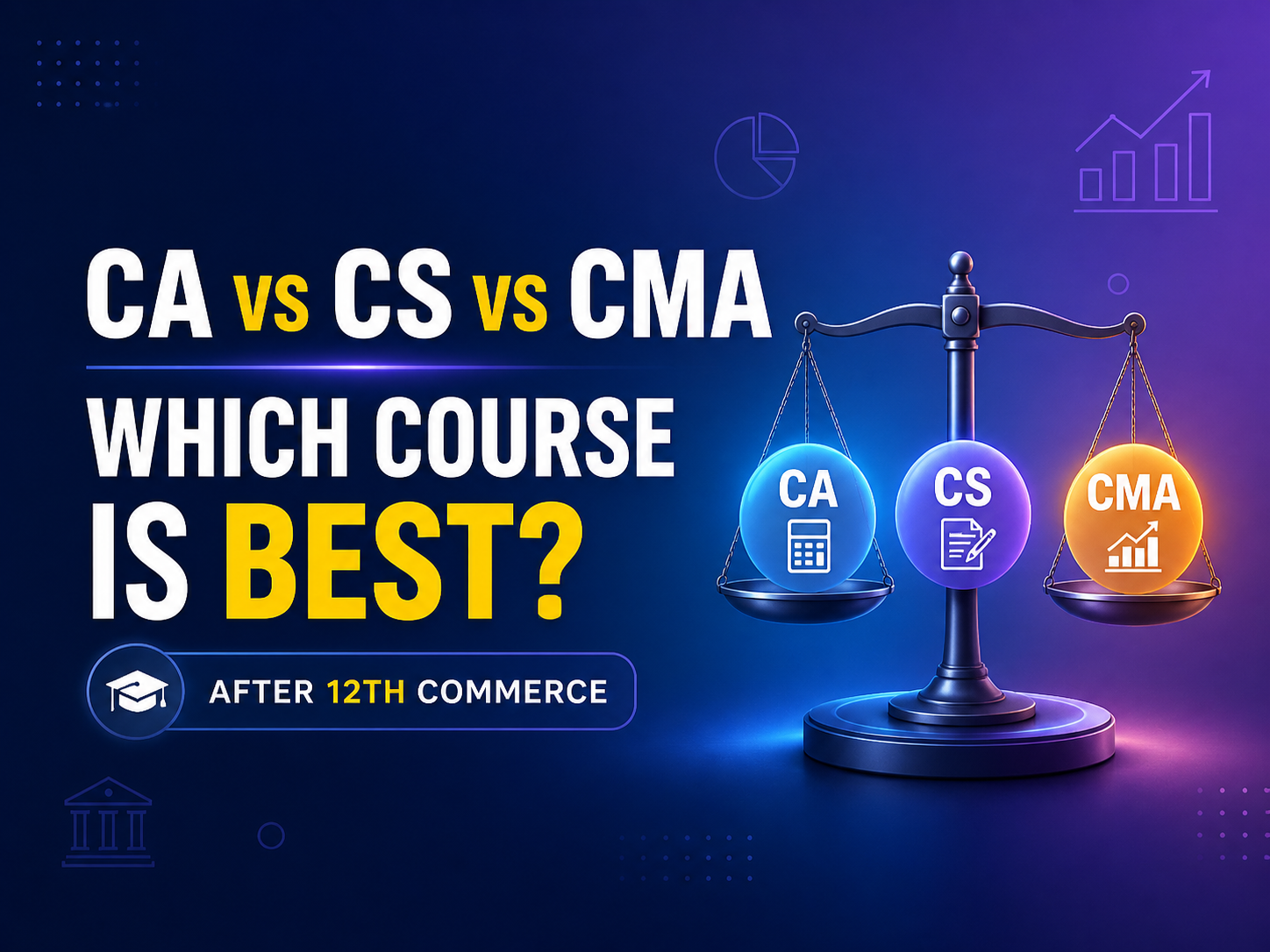
CMA vs CA vs CS — Which Should You Choose?
All three are premier professional qualifications in India — but they serve different career paths. Here's a quick comparison to help you choose.
📈 CMA
Best for: Cost management, manufacturing, PSUs, budgeting. Less competition, strong PSU demand, faster completion than CA.
📊 CA
Best for: Audit, taxation, Big 4 careers, CFO roles. Highest earning potential, most prestigious — but toughest exam.
⚖️ CS
Best for: Corporate law, governance, compliance. Every listed company must have a CS — mandatory demand.
| Parameter | CMA (ICMAI) | CA (ICAI) | CS (ICSI) |
|---|---|---|---|
| Focus | Cost & Management Accounting | Audit, Tax & Finance | Corporate Law & Governance |
| Governing Body | ICMAI | ICAI | ICSI |
| Total Levels | 3 (Foundation, Inter, Final) | 3 (Foundation, Inter, Final) | 3 (CSEET/Foundation, Executive, Professional) |
| Difficulty | Moderate to Hard | Very Hard (toughest) | Moderate |
| Inter Papers | 8 papers | 6 papers (new scheme) | 6 papers (new scheme) |
| Duration | 3–4 years | ~3.5–4 years (new scheme) | 3–4 years |
| Practical Training | 15 months | 2 years (new scheme) | 21 months |
| Fresher Salary | ₹4–8 LPA | ₹6–12 LPA | ₹4–7 LPA |
| Best Sectors | PSU, Manufacturing, Steel, Pharma | Big 4, Banking, Corporates | Listed Companies, MCA Compliance |
💡 Pro Tip: CMA CA or CMA CS dual qualification significantly boosts your earning potential and career options. Dual-qualified professionals are rare and highly valued — starting salaries of ₹15–20 LPA for freshers are common with two qualifications.
Excel Educational Institute — CMA Coaching in Raipur
EEI offers dedicated CMA Foundation, Inter & Final coaching in both Hindi and English medium — with Chhattisgarh's highest pass rates. With 173 All India Rankers across CA, CS & CMA and 18 years of experience, EEI provides expert faculty, daily doubt sessions, mock test series, and complete ICMAI syllabus coverage. Batches enrolling for June & December 2026 — limited seats.
.jpeg)