 99268 21000
 99268 21000
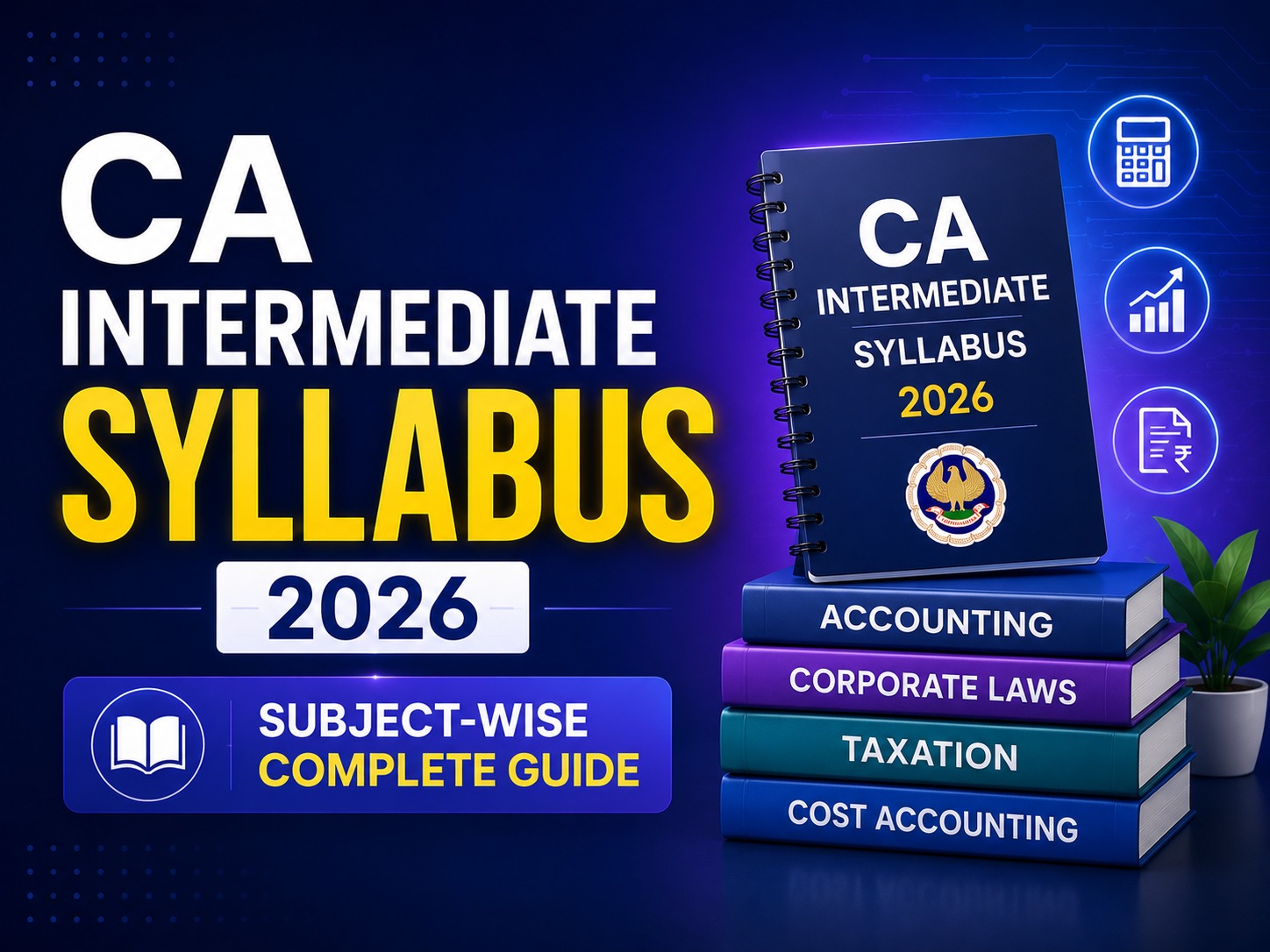
CA Intermediate Syllabus 2026: Subject-Wise Complete Guide
All 6 papers, chapter-wise topics, weightage, exam pattern, and preparation tips — for both Hindi & English medium students
CA Intermediate is the second and most critical level of the Chartered Accountancy course — the bridge between basic accounting knowledge and the advanced professional standards of CA Final. Under ICAI's New Scheme of Education and Training (effective from May 2024), the Intermediate syllabus has been restructured from 8 papers to 6 focused, industry-aligned papers. This complete guide covers every paper, every chapter, key weightages, and subject-wise study tips — for both Hindi and English medium students preparing for the September 2026 session.
Quick Summary — CA Intermediate 2026
6 papers across 2 groups of 3 · 600 total marks · 70% Descriptive 30% MCQ (case-based) · No negative marking · Pass: 40% per paper 50% aggregate per group · Both Hindi & English medium available · Exams: January, May & September each year
📋 Table of Contents
Exam Pattern & Key Facts — CA Intermediate New Scheme 2024
Before studying the syllabus, understand the structure you are preparing for. The new scheme changes are significant — especially the reduction from 8 to 6 papers and the introduction of case-based MCQs.
| Parameter | Details |
|---|---|
| Number of Papers | 6 Papers (reduced from 8 under new scheme) |
| Groups | 2 Groups — Group I (Papers 1–3) and Group II (Papers 4–6) |
| Marks per Paper | 100 marks each · Total: 600 marks |
| Question Format | 70 marks Descriptive 30 marks Case-based MCQ |
| Negative Marking | ❌ No negative marking in MCQs |
| MCQ Type | Case-scenario-based (not standalone) — tests application, not memory |
| Exam Duration | 3 hours per paper (2 PM – 5 PM) |
| Exam Mode | Offline — Pen-and-paper at ICAI exam centres |
| Passing Criteria | 40% in each paper AND 50% aggregate per group |
| Group Attempt | Can attempt Group I only, Group II only, or Both together |
| Exam Frequency | 3 times per year — January, May, September |
| Medium | Hindi or English (student's choice) |
| Articleship | 2 years — begins only after clearing BOTH groups (new scheme) |
⚠️ Important — MCQ Negative Marking: While there is no negative marking for the 30-mark MCQ section in CA Intermediate descriptive papers, the MCQs are case-scenario-based — meaning they require conceptual understanding, not guessing. Attempt all MCQs confidently but always eliminate wrong options rather than blind-guessing.
Advanced Accounting
The most practical and numerical paper of Group I — and a favourite for scoring high marks. It builds on Foundation-level accounting and introduces Accounting Standards (AS), company accounts, and consolidated financial statements. Daily practice is non-negotiable.
-
1Accounting Standards (AS 1–AS 29)Disclosure, Cash Flows, Inventories, Leases, Investments, Impairment, EPS, Deferred Tax — highest weightage45–55%
-
2Company AccountsFinancial statements under Schedule III — P&L, Balance Sheet, Cash Flow; Bonus/Rights issues10–15%
-
3Amalgamation & ReconstructionPurchase consideration, pooling/purchase method, internal and external reconstruction10–15%
-
4Consolidated Financial StatementsSubsidiary and associate consolidation, goodwill, minority interest / NCI10–15%
-
5Accounts of Special EntitiesBanking companies, NBFC, electricity companies, LLP accounts, partnership dissolution10–15%
-
6Framework for Financial ReportingConceptual framework, objectives, qualitative characteristics5%
Study Tip: Accounting Standards carry 45–55% of the paper — they must be your priority from Day 1. Amalgamation and Consolidation are Category A topics — compulsory questions appear from these. Practice at least 2 full numericals per chapter daily.
Corporate & Other Laws
This paper covers key legislation governing corporate India — primarily the Companies Act 2013. Case-study-based MCQs and application-based descriptive questions make this a concept-driven paper. Memorising section numbers and their implications is essential.
-
1Companies Act 2013 — Part I (Core Provisions)Incorporation, share capital, meetings, directors, Board, winding up, charge — highest weightage60–65%
-
2Limited Liability Partnership Act, 2008LLP formation, rights and duties, winding up, conversion8–10%
-
3The General Clauses Act, 1897Definitions, rules of interpretation, application to statutes5%
-
4Interpretation of StatutesRules of construction, aids to interpretation, ejusdem generis5%
-
5Other Laws — FEMA, IBC (Basics), SEBIForeign exchange management, insolvency and bankruptcy code basics, SEBI regulations15–20%
Study Tip: Companies Act 2013 dominates this paper. Learn section numbers for commonly tested provisions (e.g., Sec 149 — Director, Sec 173 — Board Meetings). For MCQs, practise case-scenario questions from ICAI RTPs where a situation is given and you must identify the applicable section.
Taxation — Direct Tax GST
One of the most amendment-heavy papers — students must prepare using the amendments applicable as of 31 October 2025 for the September 2026 exam. It is split into two mandatory sections: Direct Tax (Income Tax, 60 marks) and Indirect Tax (GST, 40 marks).
-
AIncome Tax — Heads of IncomeSalary, House Property, PGBP, Capital Gains, Other Sources — computation-based numericals30–35 Marks
-
ADeductions, Setoff & Carry ForwardChapter VIA deductions (80C, 80D, 80G etc.), loss set-off rules, basic assessment15–18 Marks
-
AResidential Status, Exemptions & TDSSec 10 exemptions, residential status determination, TDS provisions (Sec 192–206AA)10–15 Marks
-
BGST — Supply, Charge & ExemptionsTaxable supply, levy and collection, composition scheme, exemption list15–18 Marks
-
BGST — ITC, Place of Supply, ReturnsInput Tax Credit rules, reverse charge mechanism, filing of GSTR-1, 3B12–15 Marks
-
BGST — Registration & Time of SupplyThreshold, mandatory registration, time and value of supply8–10 Marks
Study Tip: Always use the Finance Act applicable for the exam — never use last year's notes without checking for amendments. PGBP (Profits and Gains from Business) and Capital Gains consistently carry the highest marks in Direct Tax. For GST, ITC rules and Place of Supply are most important.
Cost & Management Accounting
A largely numerical paper focused on cost determination, control, and decision-making. Students who practice consistently find this highly scoring — it is often used to boost aggregate marks. Both theory and numerical questions require equal attention.
-
1Cost Sheet & Cost Accounting BasicsClassification, concepts, cost sheet preparation, prime cost, conversion cost10–12%
-
2Material, Labour & Overhead CostingEOQ, FIFO/LIFO, idle time, overtime, absorption, departmental overhead18–22%
-
3Process Costing & Joint ProductsNormal/abnormal loss, joint cost apportionment, by-products10–15%
-
4Marginal Costing & CVP AnalysisBEP, P/V ratio, margin of safety, make-or-buy decisions, key factor analysis15–20%
-
5Standard Costing & Variance AnalysisMaterial, labour, overhead variances — computation and interpretation12–18%
-
6Budget & Budgetary ControlTypes of budgets, flexible budgets, zero-based budgeting, control ratios10–12%
-
7Activity-Based Costing (ABC)Cost drivers, cost pools, comparison with traditional absorption costing8–10%
Study Tip: Marginal Costing and Standard Costing are the most exam-frequent and highest-scoring topics. Practice every variant of BEP and variance calculations. For process costing, solve at least 10 problems involving abnormal loss/gain with by-products before the exam.
Auditing & Code of Ethics
Auditing rewards students who understand the why behind each Standard on Auditing (SA), not just the what. It is a conceptual paper where keywords, structured presentation, and case-study application are the differentiators for high marks.
-
1Nature, Objective & Scope of AuditTypes of audit, audit vs investigation, professional scepticism5–8%
-
2Audit Strategy, Planning & Risk AssessmentSA 300, SA 315 — understanding the entity, risk assessment procedures12–15%
-
3Audit Evidence & Procedures (SA 500-series)SA 500, 501, 505, 520 — audit procedures, external confirmations, analytical procedures18–22%
-
4Internal Control & Audit SamplingSA 265, SA 530 — evaluation of internal controls, statistical sampling10–12%
-
5Audit Reporting (SA 700-series)Audit report, modifications, emphasis of matter, going concern (SA 705, 706, 570)12–15%
-
6CARO 2020Specific CARO reporting requirements — clause-wise understanding5–8%
-
7Code of Ethics — ICAIFundamental principles, threats, safeguards, independence rules15–20%
Study Tip: Learn SA numbers along with their subject matter — examiners expect you to quote SAs correctly. Ethics is the most reliably scoring area — prepare it thoroughly. For every SA, understand 2 things: (1) its objective and (2) its key procedure, then practise writing exam-style answers with proper headings.
Financial Management & Strategic Management
This paper has two equal sections — Section A: Financial Management (50 marks) is numerical and formula-driven, while Section B: Strategic Management (50 marks) is conceptual and theory-based. Both sections carry equal weight, making balanced preparation across both mandatory.
-
ACapital Budgeting & Investment DecisionsNPV, IRR, Payback Period, risk analysis — most scoring FM topic15–18 Marks
-
ACost of Capital & LeverageWACC, financial and operating leverage, EBIT-EPS analysis10–12 Marks
-
ACapital Structure & Dividend DecisionsOptimal capital structure theories, MM theory, dividend policy models8–10 Marks
-
AWorking Capital ManagementCash, debtors, inventory management, operating cycle, CCC8–12 Marks
-
BIntroduction to Strategic ManagementVision, mission, objectives, strategic planning process8–10 Marks
-
BBusiness Environment AnalysisPESTEL, Porter's Five Forces, SWOT — application to case studies12–15 Marks
-
BGeneric & Corporate StrategiesPorter's generic strategies, Ansoff matrix, BCG matrix, Blue Ocean12–15 Marks
-
BStrategic Implementation & EvaluationBalanced Scorecard, strategy implementation challenges, control mechanisms8–10 Marks
Study Tip: For FM, master the NPV and IRR calculations first — they appear in almost every exam. For Strategic Management, study each framework (Porter, Ansoff, BCG) with real business examples so you can apply them to case-based MCQs and descriptive questions effectively.
Complete Comparison — All 6 Papers at a Glance
A one-stop reference table for all six CA Intermediate papers — groups, topics, difficulty, and study priority for the September 2026 attempt.
| Paper | Subject | Group | Type | Difficulty | Priority |
|---|---|---|---|---|---|
| P1 | Advanced Accounting | Group I | Numerical Theory | ⭐⭐⭐⭐⭐ | 🔴 Very High |
| P2 | Corporate & Other Laws | Group I | Theory Case-Study | ⭐⭐⭐ | 🟡 High |
| P3 | Taxation (DT GST) | Group I | Numerical Theory | ⭐⭐⭐⭐ | 🔴 Very High |
| P4 | Cost & Management Accounting | Group II | Numerical Theory | ⭐⭐⭐⭐ | 🟡 High |
| P5 | Auditing & Code of Ethics | Group II | Theory Case-Study | ⭐⭐⭐ | 🟡 High |
| P6 | Financial Management & Strategic Management | Group II | Numerical (FM) Theory (SM) | ⭐⭐⭐ | 🟢 Medium-High |
Hindi Medium vs English Medium — CA Intermediate 2026
ICAI allows students to write CA Intermediate exams in either Hindi or English. Both mediums are fully supported with official study material from ICAI's Board of Studies.
🇮🇳 Hindi Medium (हिंदी माध्यम)
- All 6 papers available in Hindi
- ICAI official Hindi study material for all papers
- Answers can be written fully in Hindi
- Mix of Hindi and English is also allowed
- No marks deduction for Hindi medium students
- EEI, Raipur offers dedicated Hindi medium batches
- Ideal for students from CG, MP, UP, Bihar, Rajasthan
- Same question papers — only answer medium differs
🏴 English Medium
- All 6 papers available in English
- More reference books and resources available
- Coaching notes and online material primarily in English
- Preferred for students targeting Big 4 or MNC careers
- ICAI's English study material is more detailed
- Recommended if technical English terminology is comfortable
- No advantage in marks over Hindi medium
- EEI also offers English medium CA Inter coaching
📌 Medium Advice for Chhattisgarh Students: If your schooling was in Hindi medium, choose Hindi — do not switch to English to appear more "professional." ICAI examiners evaluate conceptual accuracy, not language preference. Many AIR rankers from CG have cleared CA Intermediate in Hindi medium.
Preparation Strategy for CA Intermediate September 2026
With approximately 3 months available from May 2026, here's how to plan your preparation effectively for the September 2026 attempt.
ICAI Study Material First
All papers — especially Advanced Accounting, Auditing, and Laws — are heavily ICAI material-based. Cover official modules before any coaching notes.
Solve RTPs & MTPs Completely
ICAI's Revision Test Papers and Mock Test Papers are the closest predictors of exam questions. Solve the last 4 RTPs for every paper before your exam.
Plan Group-Wise Preparation
Decide early: one group or both? If time is tight, clear Group I first (Accounting, Laws, Taxation) — it has the foundational subjects that support Group II.
Master Amendment Updates
Paper 3 (Taxation) changes with every Finance Act. Amendments applicable up to 31 October 2025 are examinable for September 2026. Use only updated materials.
Attempt All MCQs — 30 Marks
No negative marking in MCQs means you should attempt every single MCQ question. Eliminate wrong options strategically — never leave MCQs blank.
Practice Answer Writing
70% of the paper is descriptive. Keywords, proper headings, and structured presentation can gain 2–3 marks per question. Practise writing in exam format.
Excel Educational Institute — CA Intermediate Coaching in Raipur
EEI offers dedicated CA Intermediate coaching for Group I & Group II — covering all 6 papers under the ICAI New Scheme 2024. Available in Hindi & English medium, with expert subject-specific faculty, RTP/MTP-aligned mock tests, daily doubt sessions, and amendment-updated study material. With 173 All India Rankers across 18 years, EEI is Chhattisgarh's most trusted CA coaching institute. Batches starting for September 2026 — enrol early for the best seat.
.jpeg)